A weekly review is a short, once-a-week session where you compare last week's plan with what actually happened and decide what next week is for. This guide walks through four steps that fit in 15 minutes, a three-column template you can copy, and how to adjust when the habit starts slipping.
If you are looking for the nightly habit of writing down what is on your mind at the end of the day, that is covered in Journaling Before Bed. This article stays at the weekly level: looking back over seven days and setting up the next seven.
What a weekly review is
The weekly review is best known from Getting Things Done (GTD), the time-management method developed by David Allen. The official GTD checklist covers a lot of ground: gathering loose papers and notes, reviewing past and upcoming calendar entries, and going through each active project one by one.
The full version often takes an hour or more until you get used to it. This guide keeps just three parts of it:
- Look at what happened last week
- Decide what to keep, drop, or change
- Choose what to do next week and put it on your calendar
The goal is not to manage every hour of the week. It is to spend less time next week wondering what to do next. Fifteen minutes is enough, at a desk or on the couch, with a notebook or a single note on your phone.
The 15-minute weekly review in 4 steps
Set a timer for 15 minutes and go in this order. When the timer ends, it is fine to stop where you are.
Step 1: Put last week's plan next to what happened (about 5 minutes)
Open your calendar and whatever notes you kept last week. Write down what you planned on one side and what you actually did on the other.
Skip the judging here. Instead of "I failed to finish the proposal on Wednesday," write "the proposal moved to Thursday." Listing facts is quick, and it keeps this step to about five minutes.
Step 2: Write one line on what held and one on what slipped (about 3 minutes)
Write one line about something that kept going last week and one line about something that stopped. Add a short reason to each: "I read on the train because I had decided on that ahead of time," or "Friday's workout got pushed out by a late meeting."
You do not need to dig for root causes. Keeping it to one line each stops the review from turning into a self-criticism session.
Step 3: Pick only three things for next week (about 5 minutes)
Narrow next week down to three things. Even if you have ten candidates, you choose three. Park the rest in a "maybe next week" list and look at them again at your next review.
Give each of the three a day and a time of day. "Tuesday morning: outline the proposal in three bullet points" is easier to act on than "work on the proposal." A meta-analysis of psychology studies found that plans spelling out when, where, and how you will act tend to make follow-through more likely.
Step 4: Put the three on your calendar and close the notebook (about 2 minutes)
Write the three things into next week's calendar. Then close the notebook. That is the end of the review.
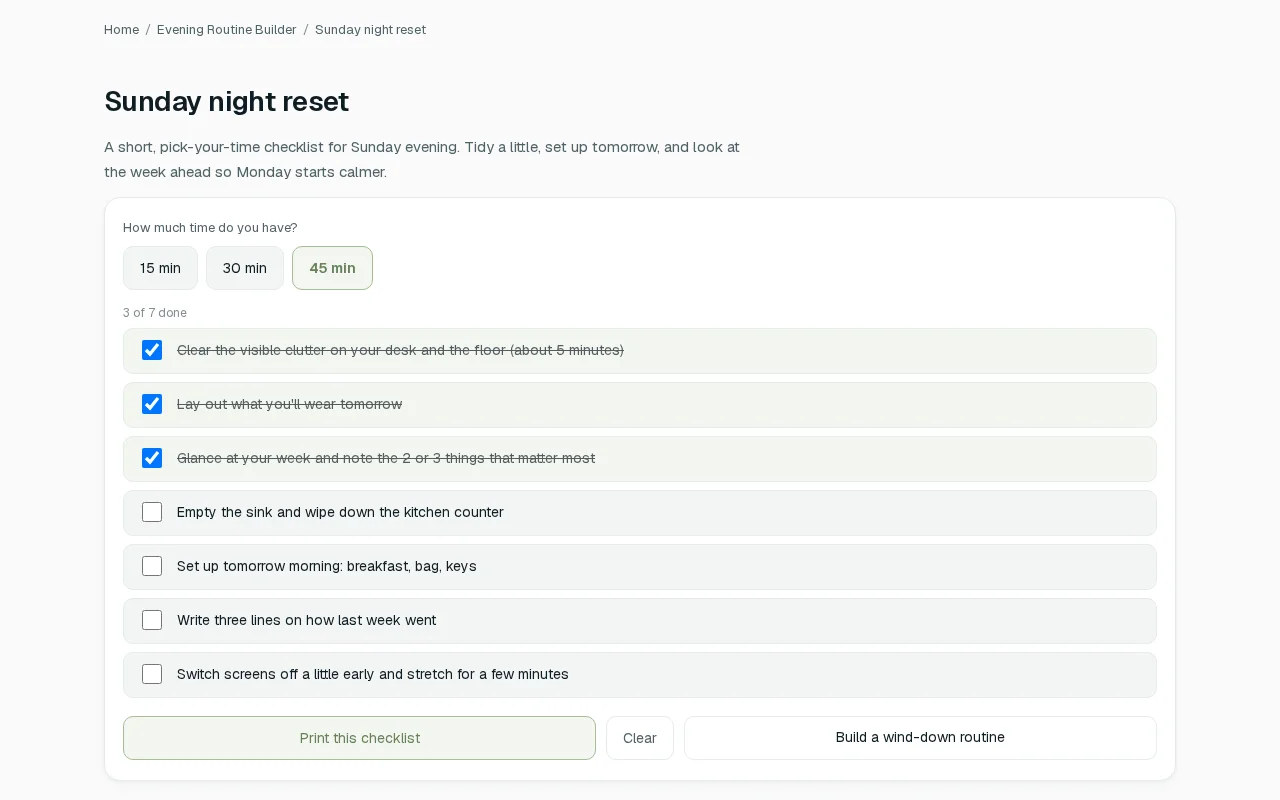
If you also want to reset your space and set up Monday morning on the same evening, the Sunday night reset has a checklist you can run in 15, 30, or 45 minutes. The 45-minute version includes writing three lines on how last week went, so on busy weeks it can stand in for the review itself.
Why Sunday evening works well
On Sunday evening, last week is fully in and next week has not started yet. It is a natural point to look back and plan in one sitting.
There is a second reason. Unfinished tasks tend to keep popping into mind until you plan for them. In a series of experiments, participants who made a specific plan for an unfinished goal no longer showed those intrusive thoughts. Those studies did not look at sleep, but they support the idea of putting next week's plan on paper before the evening winds down.
Once the review is done, let the planning go for the night. If you would like a set shape for the rest of the evening, the Evening Routine Builder takes the time you want to be in bed and how much time you have, and lays out the evening with times for things like a bath and dimming the lights. Placing the 15-minute review before that routine starts may help keep planning out of the last hour of the day. It is free, runs in your browser, and needs no signup.
If Sunday evening does not work for you, Friday afternoon or Monday morning are fine too. What matters most is keeping the same day each week.
A weekly review template
Copy these three columns into a notebook, or print this page and write on it. The first rows show an example.
| What I saw (last week's facts) | What I decided (keep, drop, or change) | Next week (with day and time) |
|---|---|---|
| Read in the morning on 4 of 5 days | Keep reading on the commute | Monday morning: pick the next book |
| Missed Friday's workout because of a late meeting | Move the workout from Friday to Saturday | Saturday morning: 30-minute walk |
| The proposal moved from Wednesday to Thursday | Put the proposal early in the day | Tuesday morning: outline it in 3 bullet points |
There are only three rules:
- The left column holds facts only, with no judging words such as "bad" or "failed"
- The middle column says keep, drop, or change
- The right column has three rows at most
Blank rows are fine. A week with few facts to list was probably a calmer week.
When the weekly review stops sticking
When the review starts slipping, take steps away instead of adding them.
- If 15 minutes feels long, do only Steps 3 and 4 and finish in five minutes
- If three things feel like too many, pick one
- If Sunday evening keeps filling up, choose another day and keep it fixed
- If filling in the template feels like a chore, write only the right-hand column
Missing a week does not mean starting over. Next week, do the usual 15 minutes without trying to make up for the week you skipped. A study of everyday habits found that missing a single opportunity now and then did not noticeably affect how the habit formed. That study looked at daily behaviors, not weekly ones, but it suggests that one missed week is not a reason to quit.
On the other hand, if the review keeps stretching toward an hour, that is often a sign it has grown too many parts. Check whether next week's list has crept past three items, or whether the left column has filled up with small details.
Frequently asked questions
Should I use a paper planner or an app?
Either works. The easiest choice is usually whatever you already use for your schedule. If your calendar lives in an app, put the three things there too, so they show up on the day.
My week is packed. How do I get it down to three?
Do not count meetings and appointments that already have a fixed time. The three are things that will only move forward if you make time for them yourself. If you still cannot narrow it down, start with the one that would make you think "next week went well" if it got done.
Can I do it with a partner or family?
Yes. One way to keep it to 15 minutes is to do Steps 1 and 2 on your own, then use Step 3 together to share only the household plans for the week, such as shopping, school runs, or guests.
Looking back mostly shows what I did not get done. It feels heavy.
Try writing only facts in the left column, with no judging words. On weeks when it still feels heavy, you can skip Step 1 and just choose one thing for next week. If a low mood lasts for weeks, or you are having trouble sleeping night after night, it is worth talking to a doctor or a support service, separately from how you run your review.
Sources
- The David Allen Company. GTD Weekly Review checklist. https://gettingthingsdone.com/wp-content/uploads/2014/10/Weekly_Review_Checklist.pdf
- Masicampo EJ, Baumeister RF. Consider it done! Plan making can eliminate the cognitive effects of unfulfilled goals. Journal of Personality and Social Psychology 101(4), 2011, 667-683. https://pubmed.ncbi.nlm.nih.gov/21688924/
- Gollwitzer PM, Sheeran P. Implementation intentions and goal achievement: A meta-analysis of effects and processes. Advances in Experimental Social Psychology 38, 2006, 69-119. https://doi.org/10.1016/S0065-2601(06)38002-1
- Lally P, van Jaarsveld CHM, Potts HWW, Wardle J. How are habits formed: Modelling habit formation in the real world. European Journal of Social Psychology 40(6), 2010, 998-1009. https://doi.org/10.1002/ejsp.674